
Your First Fragrance Order, Desk by Desk: A Trained Team's Walkthrough
A first fragrance order is not one project; it is five or six decisions that pass between a small number of desks, and the order only runs as fast as the slowest handover. A team that has been through perfumery training recognises the shape of those handovers, which means the brief is written once, the samples are judged against criteria, and the compliance questions are asked before the packaging is printed rather than after. This walkthrough follows one direct-to-consumer brand through that sequence, noting at each step what changes when the team knows what it is looking at.
Key takeaways
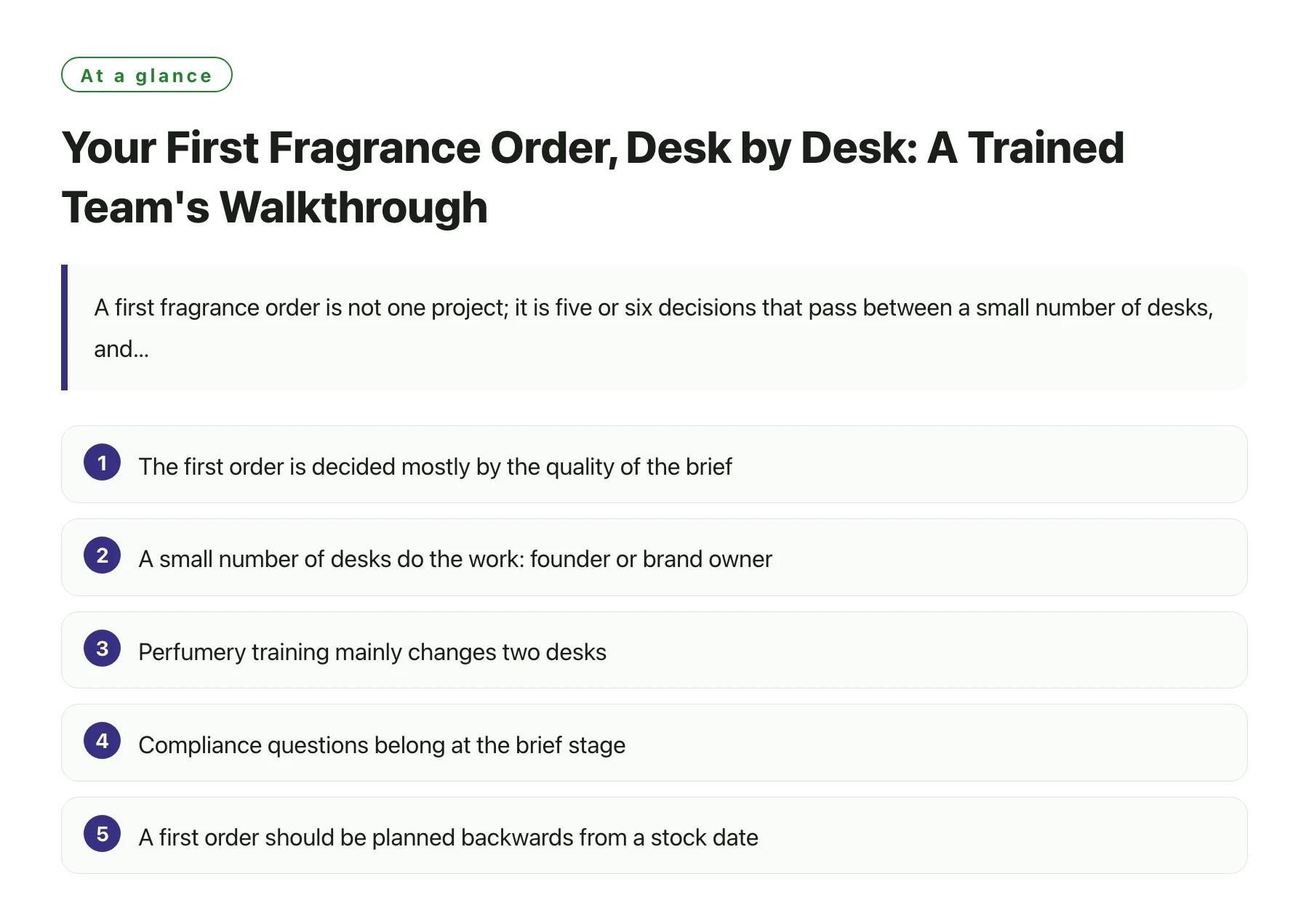
- The first order is decided mostly by the quality of the brief, because everything downstream, including the samples, the testing and the label, is derived from it.
- A small number of desks do the work: founder or brand owner, product development, the factory's account and technical contacts, and whoever handles compliance and freight.
- Perfumery training mainly changes two desks, the brief and the sample review, where a team that can describe a scent accurately saves a full revision round.
- Compliance questions belong at the brief stage, because in many markets the brand placing the cosmetic on the market is the party that must hold the safety assessment and product information file [1].
- A first order should be planned backwards from a stock date, with packaging, testing and documentation treated as dependencies rather than as paperwork.
First fragrance orders go wrong in predictable ways, and almost none of them involve a dramatic failure at the factory. They go wrong because a decision that belonged at one desk was made at another, late, with partial information: packaging ordered before the formula was frozen, artwork approved before the ingredient declaration was confirmed, a launch date announced before testing had a window.
The walkthrough below is written for the person who ends up holding the project, usually a founder or a product lead doing three jobs at once. It follows the order of work rather than the order of a contract, and it flags the points where a brand team's own capability, rather than the supplier's, sets the pace.
Nothing here requires a technical background, but it does assume the team has some shared scent vocabulary, because two of the steps are impossible to run well without it.
The first order, handover by handover
- Desk one: define the product before the scentDecide the format, the concentration, the price point, the channels and the markets, because the scent brief is derived from those choices and not the other way round.
- Desk one to two: write the briefA single page naming the reference, the intended impression, the products the scent must work in and the performance it has to hold, reviewed by whoever will judge the samples.
- Desk two: agree the development approachConfirm whether the scent is developed from the brief or selected from a library, how many directions are included, and who approves each round.
- Desk two: judge the samples against criteriaScore each direction on the same line items, comment on the top, heart and base separately, and return one consolidated response rather than three opinions.
- Desk two to factory: freeze the formula and the specificationRecord the approved direction, the concentration, the reference unit and the specification in one dated document, and confirm the retained reference is held on both sides.
- Desk three: settle compliance inputsConfirm the ingredient declaration, the safety assessment route, the product information file and who is named as the responsible party, well before artwork is finalised [1].
- Desk three: lock packaging and decorationPlace bottle, pump, cap, decoration and carton orders against the frozen specification, with component dates that land before the filling slot rather than near it.
- Desk two and three: release bulk, then shipCompare the bulk against the retained reference, read the batch record, confirm the pre-shipment photographs, then release against the agreed criteria.
- Desk one: review the first saleRead the first reviews and returns against the brief, because the first order is also the data collection exercise for the second.
Where training changes the outcome
Two steps in that sequence are transformed by a team that can smell and describe. The brief step becomes specific, because the team can name a reference, a direction and the performance it expects rather than describing a mood. The sample review step becomes a decision rather than a discussion, because the criteria were written before the samples arrived.
A useful illustration is the way a trained team handles the drydown. Untrained reviews often happen in the first two minutes, when the opening is loudest, and the decision is made on a phase that lasts a fraction of the product's life. A team that knows how a fragrance unfolds smells the same sample again an hour later, and discovers that the direction which excited everyone in the room has lost the base it needed. That single habit prevents a launch built on a promising top note.
The desk that most often becomes the bottleneck
It is usually the brand's own sample review, not the factory. Sample rounds wait on consolidated feedback, and consolidated feedback waits on one person deciding. Teams that name a single reviewer, and give that person a fixed window, remove more time from the calendar than any negotiation with a supplier the steps behind a new fragrance brand.
The same applies to artwork. Most first orders lose days waiting for a label approval that could have happened in parallel with a later sample round, because the team assumed the approvals had to be sequential.
What to record as you go
A first order generates a surprising amount of information that is only valuable if it is kept: the brief, the scored sample sheets, the frozen specification, the retained reference, the batch record, the test reports and the compliance inputs. Held together, this becomes the operating manual for the second order, when the same decisions have to be made faster and with less attention.
Where a brand intends to grow a range, the record also shows what can be reused. A concentration, a bottle platform and an ingredient declaration can often carry across products, while testing generally cannot, because each format and package combination is a separate case.
Founders who want to build the capability rather than learn it during a live launch usually start with a short programme, which is why Xuelei fragrance education is often the first thing a brand team books before it books a sample round, and why teams that have completed some training tend to ask prospective partners different questions from the start, particularly of a Chinese factory for perfume brands with a long order book.
If a first order has to be simplified, simplify the range rather than the process. One product, one scent, one package, run through the full sequence, teaches a team more than a four-item range run badly, and it produces a reusable record. The second order is then a variation on a known process instead of another first attempt. The walkthrough above is the same route a structured manufacturer will describe when asked, and the fastest way to test a candidate partner is to walk through it together and see which steps they cannot place. That test costs one meeting and it works the same way on any manufacturer, whether the candidate is XUELEI or a smaller workshop, because the sequence does not change with the size of the company.
Sources
- European Commission: Cosmetics in the EU —— The European Commission's overview of EU cosmetics rules, including the responsible person, product information file and safety report requirements.
Frequently asked questions
How many products should a brand launch in a first fragrance order?
One hero product is usually the most instructive, because it exercises the full sequence from brief to compliance without multiplying the decisions. A range can follow once the process, the specification and the documentation pattern are established.
What should be decided before writing the fragrance brief?
The format, the concentration, the price point, the sales channels and the markets. The brief is derived from those choices, and a brief written before them tends to describe a scent the brand cannot actually sell at the intended price.
Who should approve samples in a small team?
One named person, with input from others collected before the review rather than during it. The most common cause of a delayed sample round is several people giving separate feedback that the manufacturer then has to reconcile.
When should compliance work start on a first fragrance order?
At the brief stage. The ingredient declaration, the safety assessment route and the party responsible for the product affect the label and the markets the product can be sold in, so they should be settled before the artwork is finalised rather than at shipment.
What should a brand keep from its first fragrance order?
The brief, the scored sample sheets, the frozen specification, a retained reference unit, the batch record, the test reports and the compliance inputs. Together these become the reference set for every later order and the evidence base if a batch is ever questioned.
Join 3.2 million readers
Daily editorial galleries, delivered fresh each morning.
Hand-picked portraits, biographical features and cultural dispatches from Budapest — free, ad-light, and curated since 2009.
Enter the Gallery