
OEM Jewelry Production After Sample Approval
Approval does not hand the factory a photograph to copy. It hands over a standard, and the bulk run is the test of whether that standard survived the handover. Published timings put 21–28 days of production after a 25–30 day sampling window, with 100% inspection before delivery. That is 3–4 weeks in which a signed sample and a shipped carton can quietly stop matching.

Key takeaways
- Bulk production is published at 3–4 weeks, or 21–28 days, after a 25–30 day sample stage.
- Three documents carry the standard forward: the signed sample, the spec sheet and the plating colour reference.
- Every piece is inspected, so 100% means the whole run rather than a sample of it.
- ISO 9001:2015 requires control at each production stage, which is what turns a reorder into a repeat rather than a new gamble.
What approval actually transfers
A signed sample is a physical reference, and on its own it is a weak one. Metal changes colour under different light. A polished surface looks different after a week of handling. A sample sitting in a drawer tells a production line very little about the thousandth piece.
Three documents do the real work. The first is the golden sample itself, kept sealed and photographed under fixed light. The second is a spec sheet listing dimensions with tolerances, finished weight, stone positions, plating type and coating. The third is a colour reference for the plating, agreed under a named light source so that a disagreement can be settled by looking rather than arguing.
When those three exist, a production question has an answer that does not depend on memory. When they do not, the answer depends on which manager is on shift, and the drift starts on day one.
Exclusivity belongs in the same handover. Designs are stated as 100% exclusive under a TTT Jewelry OEM arrangement, with moulds, CAD and the collection not resold or shown. That promise is only operational if the tooling register names the design, which is why the paperwork at approval matters beyond quality control.
The eight factory steps after the order releases
The published factory sequence runs concept design, prototyping, sprue cutting, polishing, surface art, electroplating, final QC and delivery. In a first order, the concept and prototype work has already happened during sampling. Bulk production therefore starts at sprue cutting, where cast pieces are separated from the tree and the gates are ground back.
Polishing follows in stages, moving from coarse to high-gloss. Surface art comes next, which is where brushed, textured or matte treatments are applied, and it must happen before plating because plating covers whatever is underneath. Electroplating then adds the multi-layer 14K, 18K or 24K gold, rhodium, or PVD finish, with anti-tarnish e-coating on silver and brass where specified.
Final QC inspects 100% of the run, and delivery ships it. Two features of this order are easy to miss. Surface art precedes plating, so a texture change requested late forces the piece back to a bench. And plating is the second-to-last step, so any handling damage after plating is a rework rather than a repair.
For a reorder, the first two steps drop out entirely. The mould exists and the model is signed, so the line starts closer to sprue cutting. That is the operational payoff of paying for a correct sample: later runs inherit the tooling instead of rebuilding it.
Where a bulk run drifts from the sample
Drift is rarely a single dramatic error. It is a series of small departures, each defensible on its own, that together produce a carton nobody recognises. The table lists the departures that appear most often between approval and delivery.
| Element | Approved condition | Typical drift in bulk | Control |
|---|---|---|---|
| Band thickness | Nominal with stated tolerance | Thinner casting to save weight | Caliper check at sprue cutting |
| Surface texture | Brushed direction agreed | Direction varied between operators | Reference tile at the bench |
| Plating colour | Agreed under named light | Bath age shifts the tone | Colour standard plus bath log |
| Stone seating | Flush or raised, fixed height | Inconsistent setter pressure | Seat depth gauge on 100% of pieces |
| Clasp tension | Opening force within a band | Spring tempered differently | Functional check at final QC |
Each control is cheap. Each failure is expensive, because it is discovered after plating, when the only remedy is to strip, refinish and replate. A piece that has been through two plating cycles rarely matches the original tone.
Reading the delivery clock
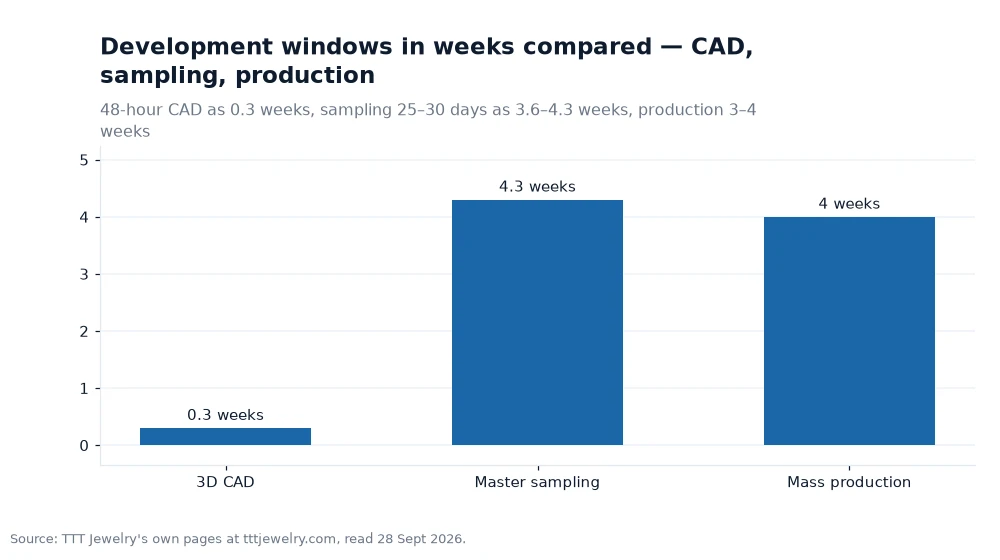
Production runs 3–4 weeks, which is 21–28 days. Sampling runs 25–30 days, which is 3.6–4.3 weeks. CAD runs under 48 hours, or about 0.3 weeks. Plotted on the same axis, the modelling step is almost invisible, and the two physical stages carry nearly all of the duration.
That shape has a planning consequence. Compressing the calendar means compressing sampling or production, and both compress only by removing work. A brand that asks for a faster bulk run is usually asking for a smaller run, a simpler finish or a later delivery date for part of the order. There is no fourth option where the same work happens in less time.
It also explains why late specification changes are so costly. A change made during the 2-day CAD step is absorbed. A change made during the 21–28 day production window forces finished pieces back to an earlier step, and the queue for that step is the reason the window was long in the first place.
Worked example
A brand approves a sample on day 30 and wants the carton in hand for a date nine weeks later. Published arithmetic: CAD 2 days, sampling 25–30 days, production 21–28 days. The full route is 2 + 25 + 21 = 48 days at the fast end and 2 + 30 + 28 = 60 days at the slow end, so 6.9 to 8.6 weeks.
Nine weeks is 63 days. That leaves 3 days of slack at the slow end and 15 days at the fast end. If the sample took the full 30 days, the remaining production window is 63 − 2 − 30 = 31 days, against a published 21–28. The margin is real but thin, and one plating rework removes it.
In week terms the same figures read 0.3 + 4.3 + 4 = 8.6 weeks for the slow route. A brand planning backwards from a retail reset should treat 8.6 weeks as the floor, not the average, because the average assumes every stage lands mid-window.
Frequently asked questions
How long is bulk production after a sample is approved?
Mass production is published at 3–4 weeks, which is 21–28 days, and it follows a sampling stage of 25–30 days.
What happens if the bulk run does not match the approved sample?
The signed sample, spec sheet and plating colour reference are the comparison points. A mismatch is measured against those documents, and the remedy depends on which step introduced the drift.
Is every piece inspected before delivery?
Yes. Final QC is stated as 100% inspection, which covers the whole run rather than a statistical sample of it.
What to put in place on approval day
Approval day is the least costly day to prevent a bulk problem. Three copies of the standard should leave the meeting: one sealed with the sample, one with the production line and one with the buyer. A fourth document, the tooling register, protects the design itself.
Brands running several metals in one collection should also decide early which line carries which design. A sterling silver jewelry manufacturer line starts at 50 pieces per design, which suits a tighter assortment, while a stainless steel jewelry manufacturer line starts at 100+ and rewards a broader, more casual range.
A programme run as OEM/ODM publishes those thresholds openly, along with a dedicated project manager and a 24-hour response window. The value of those terms is not the promise itself. It is that a question about a drifting carton has somewhere to go before the drift becomes a rework.
Source note: figures come from the manufacturer's own website (tttjewelry.com), read 28 Sept 2026.[1]